Why small businesses waste money on marketing
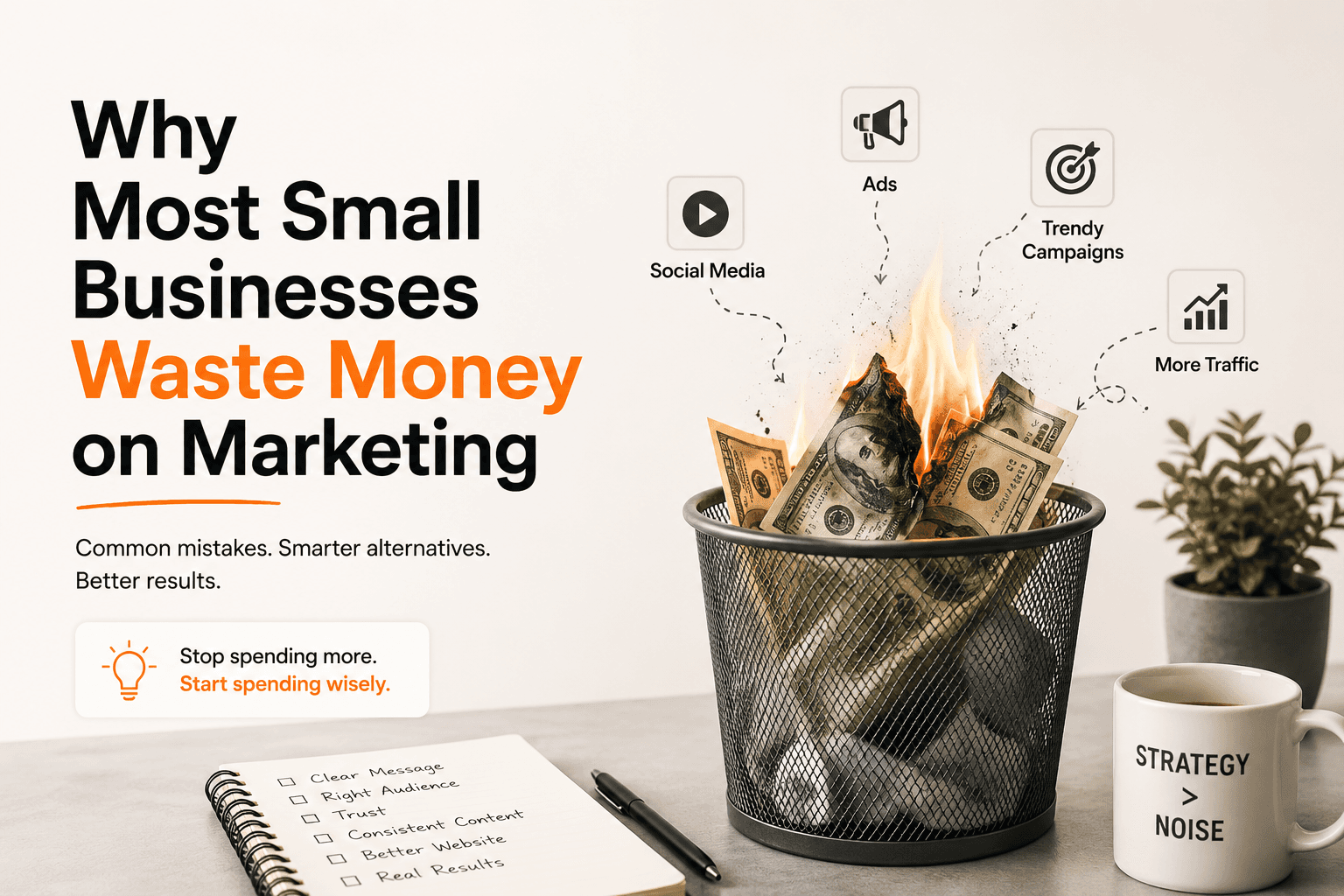
Why small businesses waste money on marketing
I've worked with enough small businesses to spot the pattern almost immediately.
A founder calls, frustrated. They've spent ₹50,000, sometimes ₹5 lakhs on ads, a new website, or a social media agency. And they have almost nothing to show for it. No real leads. No meaningful sales. Just a lighter bank account and a lot of confusion.
The thing is they didn't waste that money because they made one big mistake.
They wasted it because of five or six small ones, stacked on top of each other.
Here's what I keep seeing.
They start with tactics, not strategy
The most common mistake. A business owner sees a competitor running Instagram Reels, so they start making Reels. They hear Facebook Ads work, so they run Facebook Ads. They read that blogging is good for SEO, so they start a blog.
None of this is wrong on its own.
The problem is doing it without asking the foundational questions first:
Who exactly is my customer?
What does that person actually care about?
Where do they spend their time?
What's the one thing that makes us better than the alternative?
Without answers to these, you're just throwing things at a wall. And most of it won't stick.
Strategy doesn't have to be a 40-page document. It can be a single page. But it has to exist before you spend a rupee.
Their website is doing them no favours
This one stings a little, because I build websites and I say this anyway:
A bad website is one of the most expensive things a business can have.
Not because it costs money to build (it does). But because it silently kills your marketing.
Here's what happens. You run an ad. Someone clicks. They land on a website that:
Takes 7 seconds to load
Has a homepage that tries to say everything at once
Buries the contact form three scrolls deep
Doesn't clearly explain what you do or who you do it for
They leave in 10 seconds. Your ad spend is wasted.
A website's job is simple: tell the visitor what you do, make them believe you're good at it, and make it easy for them to take the next step.
If it's not doing those three things, no amount of ad budget will save you.
They're advertising to everyone (Which is the same as no one)
I ask almost every client the same question: "Who are you trying to reach?"
The most common answer I get: "Everyone who needs our product."
That sounds logical. It's actually a disaster for marketing.
When you try to speak to everyone, your message becomes so broad it connects with no one. You end up with generic ads, generic copy, generic results.
The businesses that get real returns from marketing know exactly who they're talking to.
Not just "women aged 25–45." But something like: "First-time mothers in Pune who are anxious about nutrition and willing to pay more for quality."
That specificity changes everything. The platform you choose, the words you use, the images you run, the offer you make.
Narrowing your audience doesn't shrink your market. It sharpens your aim.
They treat ads as a magic button
There's a version of digital advertising that works brilliantly. And there's a version that burns money.
The difference is usually what happens after the click.
A lot of small businesses think running ads is the whole job. Run the ad → get customers. But ads are just the first step in a chain. And if any link in that chain is broken, the whole thing fails.
The chain looks like this:
Ad → Landing page → Offer → Follow up → Sale
If your ad is good but your landing page is confusing - you lose them.
If your landing page is good but your offer is weak - you lose them.
If your offer is good but no one follows up with the lead - you lose them.
I've seen businesses run decent ads, get real clicks, and then have someone WhatsApp the number two days later because no one responded to the enquiry. That sale is gone.
Ads amplify what's already there. If the rest of the process is broken, ads just amplify the problem.
They don't know their numbers
This is the one that surprises people most when I bring it up.
Most small business owners can't tell me:
What it costs them to acquire one customer
What that customer is worth over 6–12 months
Which channel brings in their best customers (not the most customers - the best ones)
Without these numbers, every marketing decision is a guess.
You might be spending ₹3,000 to get a customer worth ₹1,500. That's a leak. And if you don't know it, you'll keep pumping water in.
You don't need a data analyst for this. A simple spreadsheet tracking:
Where each lead came from
How many converted
What they spent
..will tell you more than most expensive marketing dashboards.
Once you know your numbers, you stop asking "should we do marketing?" and start asking "where do we put the next ₹10,000 for the best return?" That's a very different and much more productive question.
They keep changing direction too quickly
Marketing takes time to work. Most business owners don't give it enough.
They run ads for two weeks, see no results, and switch to something else. Or they post on Instagram for a month, don't go viral, and give up.
Meanwhile, the businesses quietly winning are the ones that picked a channel, got decent at it, and stayed consistent for six months before evaluating.
There's a version of this that's smart. If something is clearly not working, stop. But "not working" after two weeks usually just means "hasn't had enough time to work."
The rule I use: give a channel or campaign at least 60–90 days and a meaningful budget before deciding it doesn't work. If you can't afford to do that, you might not have enough budget to test that channel properly yet.
They outsource without understanding the basics themselves
Hiring an agency or a freelancer can be great. I am one, so I'm obviously not against it.
But there's a trap here.
When founders hand off marketing without understanding it themselves, two things happen:
First, they have no way to evaluate if the work is good. They look at follower counts and "impressions" and feel like something is happening. Even when sales aren't moving.
Second, they can't ask the right questions. So the agency keeps doing what they're doing, the founder keeps paying, and nobody's held accountable for real results.
The fix isn't to become a marketing expert. It's to understand enough to ask:
What is the goal of this campaign?
How are we measuring success?
What does a good result look like in 90 days?
If your agency or freelancer can't answer those questions clearly that's a red flag.
Their offer is the problem, not their marketing
Sometimes I look at everything a business is doing and it's actually pretty solid. Decent ads, reasonable website, okay follow-up.
And still nothing is working.
More often than people like to admit, the issue is the offer itself.
Either the price is off, the product doesn't solve a real pain, or the promise isn't compelling enough to make someone act.
Marketing can bring people to your door. It cannot convince someone to buy something they don't want or pay a price that doesn't feel fair.
Before blaming the ads, ask: if a trusted friend sent this offer to you, would you buy it?
If the honest answer is "probably not". Fix the offer first.
The Short Version
Most small businesses don't waste money on marketing because marketing is hard.
They waste it because:
They start with tactics before strategy
Their website is losing them customers quietly
They try to talk to everyone instead of someone
They treat ads as the whole job instead of one step
They don't track the numbers that matter
They switch directions before anything has time to work
They outsource without knowing enough to hold people accountable
Their actual offer isn't strong enough
Fix these. Even partially and you'll get more out of whatever you're already spending.
Marketing isn't complicated. But it does require the right foundation before you start.
If you're a small business owner or founder who wants a second pair of eyes on your website or marketing. I'm happy to take a look and tell you where I think the gaps are. No pitch, just an honest conversation. Reach me

Rahul Singh
Framer Designer & AI Consultant
Written by a Framer designer and AI consultant based in Pune. I write about design, AI implementation, and building a freelance business. More about Rahul.
You may also like to read
Subscribe now!
Get latest insights first. No spam thats my promise.