UGC ads for small business: How to make one that converts
UGC ads for small business: How to make one that converts
UGC ads outperform polished brand ads for one reason. They feel real. Here's a complete breakdown: what UGC is, why it works, a real sample script, and how to make your first one from scratch.
Why a phone video Is outselling studio ads
If you've been scrolling Instagram or YouTube lately, you've seen UGC ads. Even if you didn't know that's what they were called.
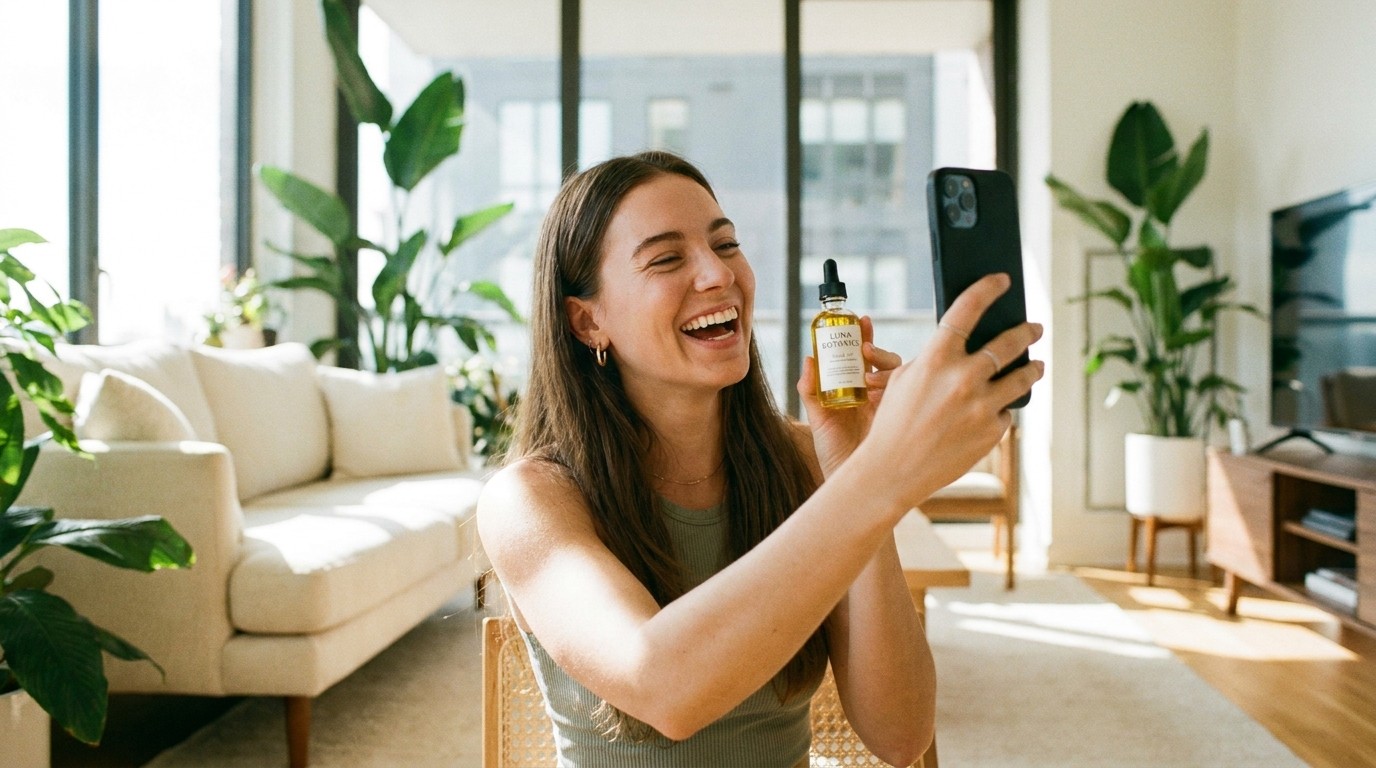
Someone talking to camera from their living room. Natural lighting. No fancy graphics. Sounds like they're just telling a friend about something they discovered.
And somehow, that 45-second video is converting better than a polished ad a brand spent ₹2 lakhs to produce.
This is UGC. User-generated content style advertising. And it's not a trend. It's a fundamental shift in how people respond to being sold to.
Here's a complete breakdown: what it is, why it works, what a real script looks like, and how to make one from scratch.
What UGC ads actually are (And what they're not)
UGC stands for user-generated content. Originally, it referred to real customers posting about products organically. No payment, no direction. Just genuine reviews and recommendations.
UGC-style ads borrowed that aesthetic and turned it into a deliberate creative strategy.
So today, when people say "UGC ad," they usually mean one of two things:
Genuine UGC: a real customer or user creates content about your product, and you pay to amplify it as an ad.
Creator-made UGC: you hire a content creator to make something that looks organic and authentic, even though it's scripted and produced intentionally.
Both work. The second is more common and more controllable.
What they share: they look and feel like something a real person made not a marketing department.
Why UGC ads outperform polished brand ads
This is the part most founders find surprising.
A brand ad announces itself. The moment someone sees a polished graphic, a voiceover, and a logo animation their brain files it under "this is an ad trying to sell me something" and the guard goes up.
UGC sidesteps that filter entirely.
When it looks like a friend talking to camera, the brain processes it differently. Closer to a recommendation than an advertisement. The guard stays down. The message lands.
UGC builds trust faster: A real person talking about a real experience is more believable than brand copy. You're not hearing from the company. You're hearing from someone like you.
UGC matches platform behaviour: On Instagram Reels, TikTok, and YouTube Shorts, people expect to see casual, direct-to-camera content. A polished ad stands out in the wrong way. It breaks the scroll pattern instead of fitting it.
UGC is cheaper to test: No studio, no big production crew, no post-production budget. You can produce 5 UGC variations for the cost of one polished ad and test which hook, which angle, which CTA actually converts.
UGC scales what's already working. If a real customer says something that resonates. You can script 10 creators to say a version of the same thing and run them all.
The anatomy of a UGC ad that converts
Most UGC ads that actually work follow a structure. It's not rigid, but the elements are almost always there.
Hook (0–3 seconds): This is everything. If the first 3 seconds don't stop the scroll, nothing else matters. A good hook states a problem the viewer has right now, makes a bold claim, or triggers curiosity.
The Build (3–20 seconds): This is where you earn the viewer's trust. Talk about the problem in their language. Show that you understand what they're going through. Don't pitch yet.
The Proof (20–35 seconds): Show the result or the change. What happened after using the product or service? Keep it specific. "I went from 3 hours to 20 minutes" lands harder than "it saved me so much time."
The CTA (35–45 seconds): One clear action. Not three options. One "Link in bio." "Tap the button below." "DM me the word X." Make it as low-friction as possible.
A sample UGC Script (With scene notes)
Here's a full script written for a productivity app targeting founders. Read it like someone talking naturally to their phone camera.
HOOK 0 to 3 seconds: "Okay, I need to tell you about something that actually fixed my chaotic morning routine." [Scene note: creator looking directly at camera, casual setting straight into it, no intro or preamble]
BUILD — 3 to 18 seconds: "Every morning I'd spend the first hour of my day just figuring out what I was supposed to be working on. Checking three different apps, going through old notes, trying to remember what I left off on the night before. By the time I actually started working, I'd already lost an hour." [Scene note: creator can be walking, making coffee, or seated natural movement is fine, even preferred]
PROOF — 18 to 35 seconds: "I started using this app about 6 weeks ago. Set it up in maybe 20 minutes. Now my morning looks like: open the app, I've got my top 3 priorities already there, and I just start. It's given me back almost an hour every single morning." [Scene note: can briefly show the screen at this point. Keep it quick, don't turn it into a tutorial]
CTA — 35 to 45 seconds: "There's a free trial linked below no credit card needed. Took me 20 minutes to set up and I've used it every day since. Genuinely worth trying." [Scene note: direct eye contact, calm delivery no forced energy or urgency]
What makes this script work: the hook is specific, the build describes the pain in exact detail, the proof uses a real number, and the CTA removes friction. The whole thing sounds like someone talking not reading.
How to make your first UGC ad from scratch
Step 1: Define the one problem you're solving. UGC ads work best when they're laser-focused. Pick one customer pain point for one type of customer. Not everything your product does just the one thing that would make someone stop scrolling.
Step 2: Write the script in spoken language. Read it out loud as you write it. If it sounds like something you'd read in a brochure, rewrite it. Avoid: "Our innovative platform leverages cutting-edge technology." Write: "I was spending 3 hours a week on something that now takes 20 minutes."
Step 3: Choose your creator. You can film it yourself (works well if you're the face of the brand), brief a genuine customer, or hire a UGC creator. Key thing: give them the structure and key points, but let them deliver it in their own words. A creator reading a script word-for-word sounds like a creator reading a script.
Step 4: Keep production simple on purpose. Natural light from a window. Phone camera. Quiet room. That's it. The moment it looks too produced, it loses the thing that makes UGC work. The feeling that a real person made it.
Step 5: Create multiple hook variations. The most important thing to test is the first 3 seconds. Film the same ad with 3 different opening lines and run all three. See which one your audience responds to before scaling spend.
Step 6: Match your landing page tone. If your ad feels personal and honest, your landing page should too. A UGC ad that sends someone to a corporate-feeling website breaks the trust the ad just built. Keep the voice consistent all the way through.
What makes a UGC ad fail
Just as important as knowing what works. Here's what kills most UGC ads.
Overly scripted delivery. If the creator sounds like they're reciting lines, the whole thing falls apart. The authenticity is the point.
Weak or generic hooks. "Have you been struggling with [problem]?" is not a hook. Start with something specific and real.
Too many messages. One ad, one problem, one CTA. The moment you try to say three things, you say nothing.
No proof. Saying a product is great without showing a specific result is just an opinion. Opinions don't convert. Results do.
Mismatch between ad and landing page. The ad builds trust. The landing page has to keep it. If the tone shifts dramatically the viewer feels it immediately.
The short version
UGC ads work because they feel like recommendations, not advertisements.
But feeling authentic isn't the same as being unplanned. The best UGC ads are carefully structured, tightly scripted, and deliberately simple.
Hook that stops the scroll. Build that earns trust. Proof that makes the claim real. CTA that removes friction.
Get those four things right and you have an ad worth spending behind.
I create UGC ad scripts and manage ad content for founders and small businesses. If you want help building out your first UGC ad from script to brief to going live feel free to reach out.

Rahul Singh
Framer Designer & AI Consultant
Written by a Framer designer and AI consultant based in Pune. I write about design, AI implementation, and building a freelance business. More about Rahul.
Subscribe now!
Get latest insights first. No spam thats my promise.