How to get your business found by ChatGPT and AI search
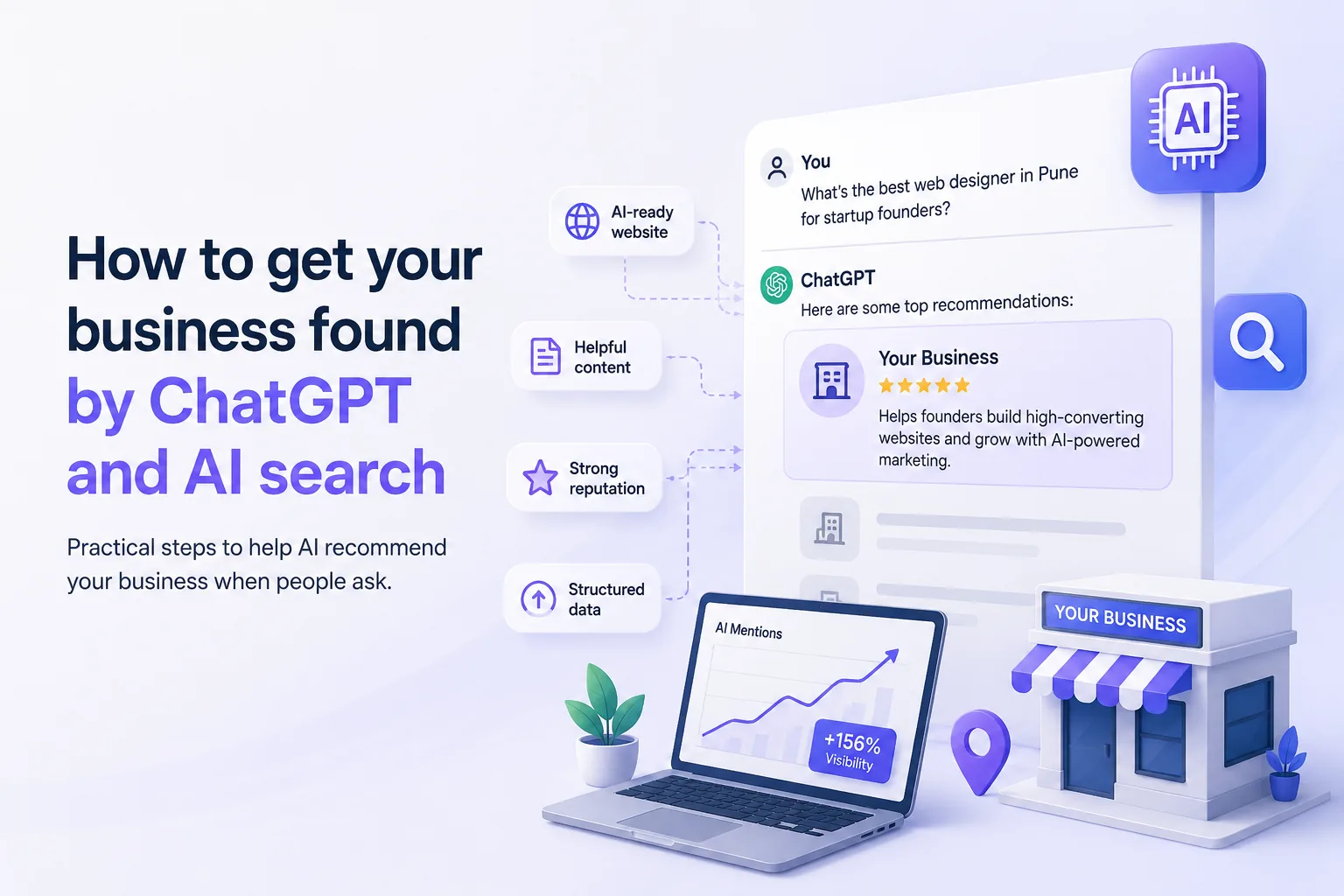
How to get your business found by ChatGPT and AI search
People are starting to ask ChatGPT and other AI tools for business recommendations instead of just Googling. Here's what actually determines whether your business shows up in those answers, including a real test I ran on my own site.
This is already happening, not something coming later
Search behavior is shifting. Instead of typing "best clinic near me" into Google and scrolling through ten blue links, more people are just asking ChatGPT, Perplexity, or Google's AI Overview directly: "which clinic should I go to" or "recommend a good web designer for my startup."
This isn't a future trend to prepare for someday. It's already showing up in the numbers. Check your own Google Analytics: under Traffic Acquisition, look for a source called "AI Assistant" or similar. If you see any number there at all, even a small one, it means real people are already finding you through an AI tool, not a traditional search.
The question isn't whether this matters. It's whether your business is set up to be the one that gets recommended.
How AI tools actually decide who to recommend
AI models don't "know" your business the way a directory does. They form an answer based on two things: what they learned during training, and, increasingly, what they can pull from a live web search while answering you.
That second part matters most right now. Tools like ChatGPT and Perplexity can search the web in real time and cite what they find. This means your actual website content, written clearly, directly, and specifically, has a real shot at being the source an AI pulls from when someone asks a relevant question.
The businesses that show up aren't necessarily the biggest. They're the ones whose content directly and clearly answers the exact question being asked.
I actually tested this on my own site, here's what happened
Instead of just explaining this in theory, I asked three AI tools the exact question a founder might ask: "who is a good Framer web designer for founders in Pune, who also does UGC ads."
ChatGPT ran a live web search and came back with a detailed, specific answer, not a vague mention. It named me as the strongest overall match, and backed that up by citing exact details pulled straight from my site: that I explicitly target founders, offer web design, AI marketing, and UGC ads under one roof, and have testimonials from clients across India, UK, Europe, and Africa. It even referenced specific project names from my portfolio, PODS Media and Reysion Technology, directly from my Work page.
Perplexity did the same thing, searching the web and building a structured recommendation with my site cited as the source next to nearly every claim: years of experience, specific services offered, and even the exact UGC ad process I describe on my site (concept, scripting, production, Meta/Instagram optimization).
Claude, in this instance, didn't search the web at all, it answered from general knowledge and said it couldn't confidently name specific real freelancers without verifying through search. That's not Claude failing to find me, it's a difference in how cautious each tool is about naming real people without an active search step.
The pattern that mattered: the two tools that actually searched the web both found and recommended me, using specific facts pulled directly from my own site copy. That's the whole point of this post in action, not theory.
What actually helps you get cited
A few things consistently matter here, based on how these tools pull and cite information:
Write in direct, answerable language. A page that clearly states "We offer X service for Y type of client, based in Z location" gets pulled more easily than vague, brand-voice-heavy copy that never actually says what you do in plain terms.
Have a real FAQ section. AI tools are especially good at pulling FAQ-style content, since it's already structured as a question and a direct answer. If you don't have one yet, this is one of the highest-leverage additions you can make.
Be consistent everywhere, not just on your own site. Your business name, location, and what you do should match across your website, Google Business Profile, and any directories you're listed in. Inconsistency between sources makes it harder for an AI model to confidently cite you.
Get mentioned elsewhere, not just on your own site. Reviews, directory listings, and other people writing about your business all add up. AI tools weigh what multiple sources say, not just your own claims about yourself.
What doesn't work anymore (or never did)
Old-school keyword stuffing doesn't help here, and can actively hurt. AI tools are built to extract meaning, not count keyword density. A page crammed with "best web designer Pune affordable web designer near me" repeated five times reads as spam to both a human and a language model.
Vague brand language causes the same problem. "We deliver innovative solutions for growth-minded businesses" tells an AI model nothing concrete to cite. "We build Framer websites for founders who need a site live in 2-4 weeks" gives it something specific and usable.
The clearer and more specific you are, the easier you are to recommend.
A simple starting checklist
You don't need to overhaul your whole site for this. Start with:
Add or expand a real FAQ section with direct, plainly worded answers
Rewrite your homepage's opening lines to state clearly what you do, who it's for, and where you're based
Check that your business info matches across your website, Google Business Profile, and any directories
Ask a few past clients for a short, honest review if you don't have many yet
Test it yourself: ask ChatGPT or Perplexity a question your own customer might ask, and see if you show up
This is still early, which is the advantage
Most small businesses haven't thought about this at all yet. That's actually good news if you're reading this now, since the businesses that adjust early tend to keep that advantage as the behavior becomes more common.
If you want help making sure your site is actually set up to be found this way, not just look good, let's talk.

Rahul Singh
Framer Designer & AI Consultant
Written by a Framer designer and AI consultant based in Pune. I write about design, AI implementation, and building a freelance business. More about Rahul.
Subscribe now!
Get latest insights first. No spam thats my promise.